

Corrupted Hagiography
by Raiana Moraes


♱⟡˙⋆This piece is a part of HAGIOGRAPHY, a digital collection of works by Guest Curator Arianna Muñoz. HAGIOGRAPHY explores the concept of the virginal, martyred girl-saint - why are we drawn to the aestheticised ‘sad girl’? Who gets the ‘privilege’ of performing this girl-saint role, and how do those outside that ideal reject or challenge it? ⋆˙⟡ ♱
⛧°. ⋆༺♱༻⋆. °⛧
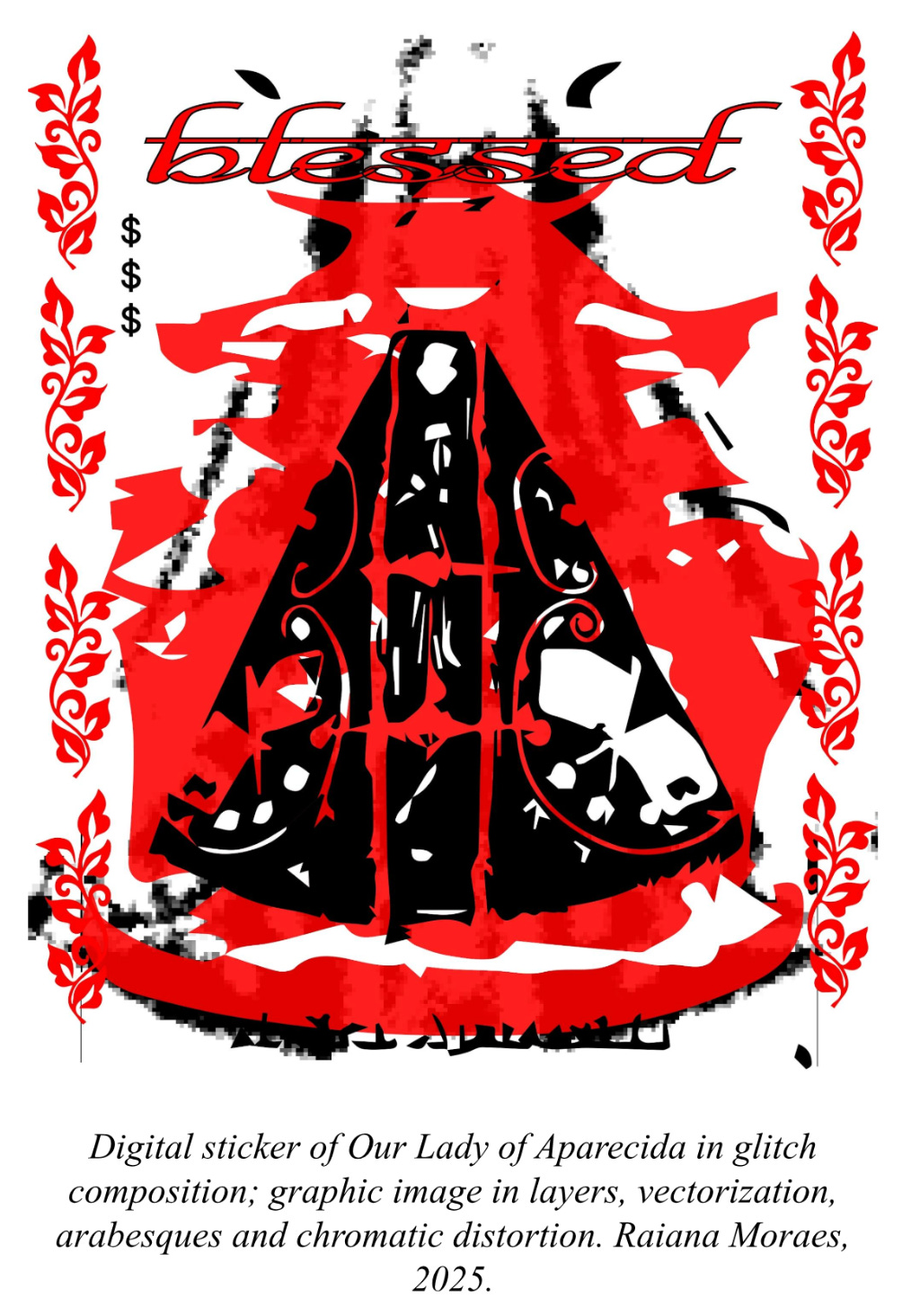
Corrupted Hagiography
she doesn’t die from purity; she survives, which is another kind of latin american miracle.
Brazilian hagiography is not merely a literary genre, but also a moral pedagogy; a machine for producing purity, a technology for controlling female and racialized bodies. The European virgin-martyr, imported as an ideal, was reenacted in tropical territory, where each sacred image carries a struggle: between sanctification and popular enchantment, between the altar and the crossroads.
It’s in this tense field that my saint is born — or rather, her glitch. An icon inherited from the colonial baroque, but traversed by digital noise, urban precariousness, and Latin American survival.
Her miracle is not dying for purity.
Her miracle is continuing to live.
Brazilian Baroque: aesthetics of excess, of wounds, of multiplied faith
Baroque hagiography in Brazil has always been less about holiness and more about survival. The gold of the churches in Minas Gerais shines over enslaved labor. The virgins are white, but the hands that carry them are not. The images are static, but the cults move in processions, drumming, prayers, songs — the Catholic saint coexisting with caboclos, old black men, enchanted beings, orixás.
Brazilian holiness is a field of conflict, a permanent negotiation between African, indigenous, and European matrices.
That is why it is never “pure” — nor should it be.
Glitch as digital heresy
If the Baroque used excess to affirm faith, glitch uses excess to expose it.
Glitch is flaw, noise, dead pixel — but it’s also revelation. It highlights the mechanism, denounces the illusion, shows the crack in the miracle.
By inserting glitch into the figure of the saint, I don’t destroy the icon: I reveal it’s historical negotiation, the erasures, the violence, the attempt at impossible harmony.
The glitched saint is like the Latin American consciousness: fragmented, interfered with, trying to maintain form under layers of noise.
She doesn’t necessarily fail, but she persists as the body persists.
And it’s in this persistence that her miracle resides.
Market Sanctification: the sticker as popular hagiography
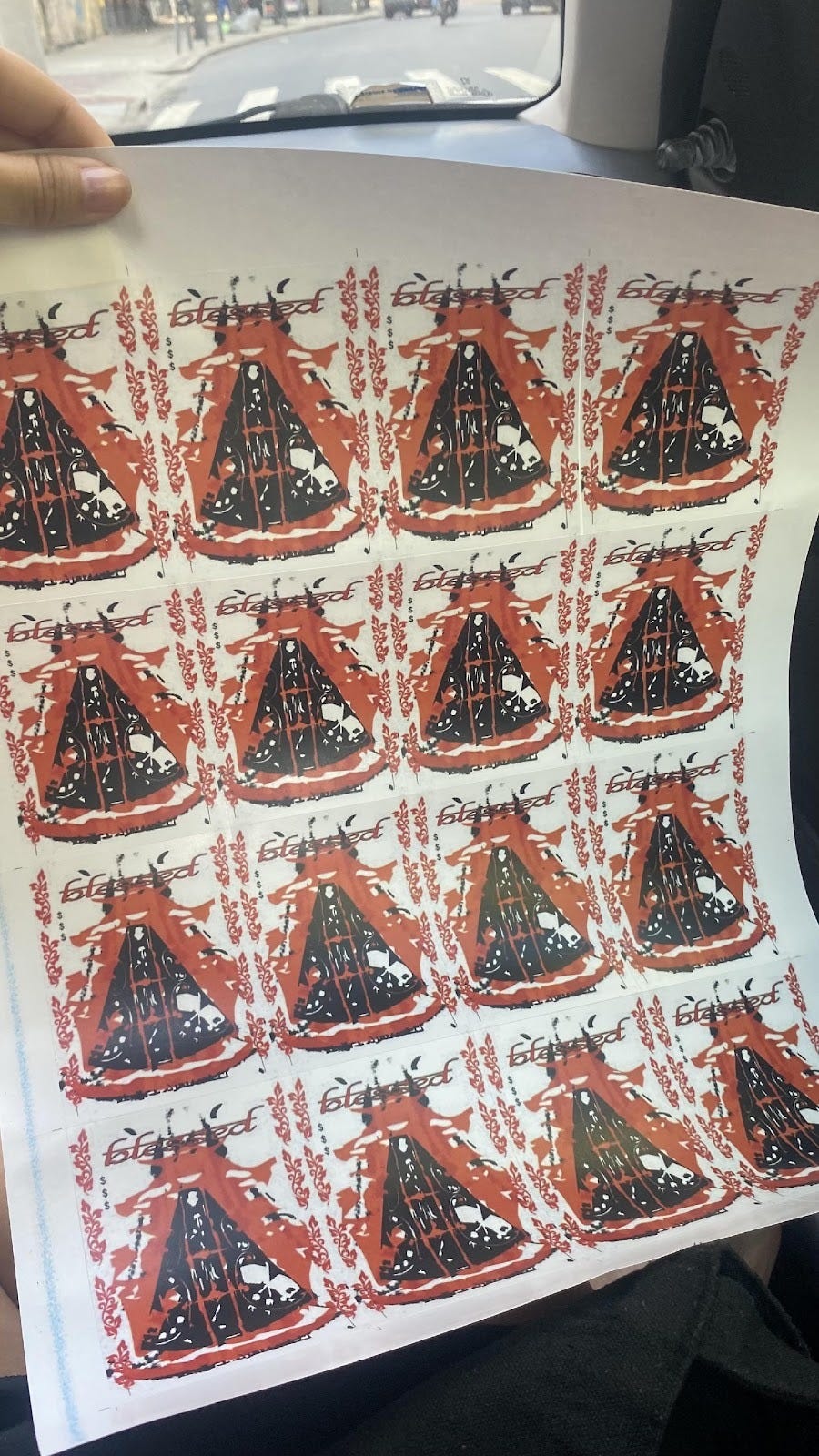
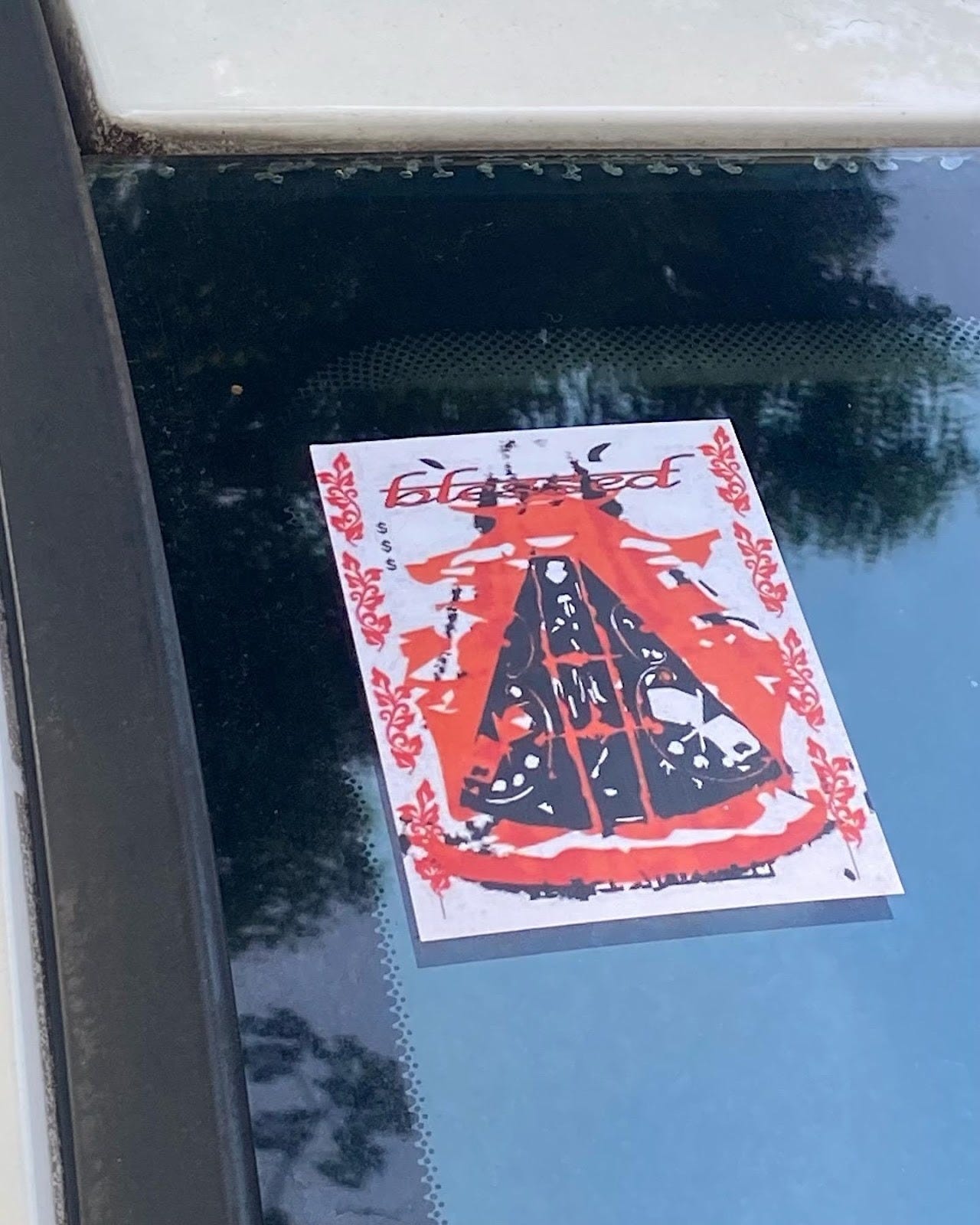
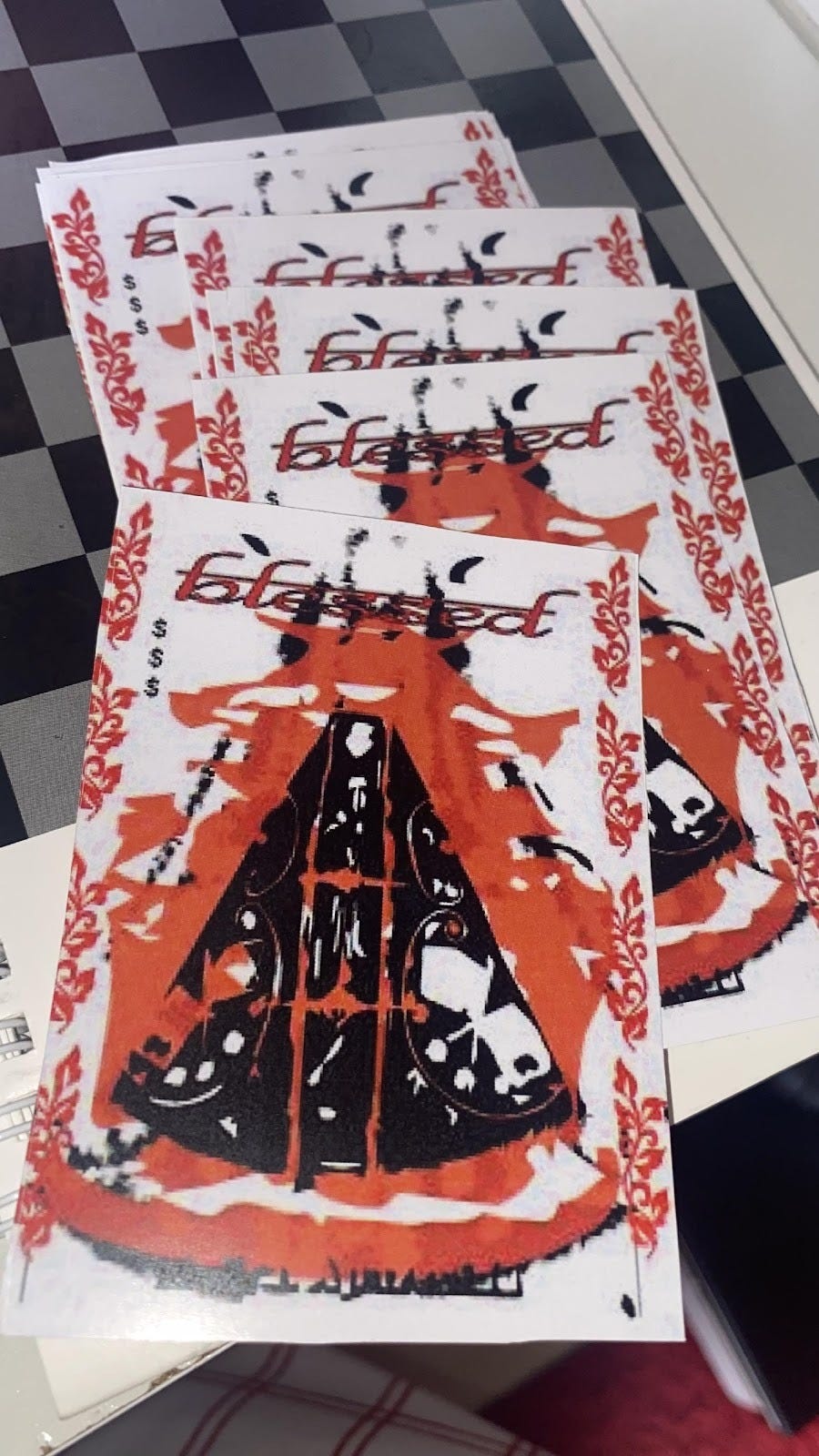
In Brazil, holiness doesn’t just live in churches — it lives on buses, in cars, on motorcycles, in rearview mirrors, in roadside markets. Car stickers are the hagiographies of everyday life: cheap prints that promise protection to those who travel amidst accidents, robberies, police violence, and precariousness.
My work starts from this popular iconography: the sticker of Our Lady of Aparecida, the patron saint of Brazil, transformed into an object of rapid circulation, an urban amulet, a portable saint.
But by corrupting this sticker into a glitch, it becomes something else: a post-digital avatar, a hybrid of devotion and noise. Simultaneous protection and collapse.
It’s no longer the intact saint of the Baroque — it is the urban saint, pixelated, precarious, trying to protect those who live on the edge of the abyss.
It’s the hagiography of collapse for those who need miracles but only receive interference.
A saint who never dies
Medieval virgins died for their purity. The glitched Brazilian saint lives despite the impurity of the material realism where she is born and reigns.
She survives the market, the patriarchy, colonialism, the algorithm. She lives because she cannot afford to die. She remains alive in a country that demands sacrifice from its women.
Her sainthood is not a promise of heaven. It’s a survival manual for the territory.
The corrupted hagiography is, therefore, a new way of narrating the life of a saint — not through the exaltation of purity, but through the celebration of noise as a possible form of existence.
A saint who blesses herself
At the top of the image, the word “blessed” appears. It’s not proclaimed by the Church, nor by any authority that legitimizes miracles. It’s the figure itself that inscribes itself as sacred, a self-generated blessing that emerges without external authorization, without required purity, without dogma to sustain it.
It’s a blessing born from noise: an act of affirmation of an image that recognizes its own flaw, that bears the marks of breakage, interference, distortion — and yet decides to continue.
The glitched saint does not expect consecration: she blesses herself, assuming for herself the task of existing despite the fracture. Her holiness is a gesture of survival. An assumption made by someone who knows she will not be canonized — and precisely for that reason it becomes a miracle.
The sacred alongside matter (or when Mammon crosses the icon)
If Baroque hagiography always tried to elevate the sacred away from the earth — to gold, to heaven, to the unattainable — the glitched saint makes the opposite movement: she falls back into matter.
In the composition, the dollar sign symbol crosses the image as interference, mark, noise. It’s not mere ornament: it’s the presence of Mammon, the god of wealth, of greed, of material desire who governs Latin American daily life as much as any saint.
By allowing Mammon and Mary to coexist in the same visual field, the image exposes a truth that official iconography tries to silence: that the sacred and the market touch each other all the time, that miracle and debt are neighbors, that faith coexists with price, that divine protection is as circulated as the products that pass through the precarious hands that consume and produce images.
Here, the sacred does not ascend — it incarnates. It gets dirty, mixes, accepts contact with money, with desire, with circulation, with survival.
The presence of Mammon does not profane the holy glitch: it reveals the environment where it truly operates — a territory where everything costs something, where miracles are always negotiated, and where holiness, in order to exist, needs to compete for space with the market.
The glitched saint does not reject matter. She traverses it, metabolizes it, and coexists with it, as one who knows that, in this country, even the sacred needs to work.
Conclusion
This work presents a corrupted hagiography that reinterprets the Brazilian Baroque tradition through glitch digital aesthetics. Starting from the popular iconography of the Our Lady of Aparecida sticker, the work challenges colonialism, religious syncretism, and market sanctification, creating a post-digital avatar: the Glitched Saint, protector of those who survive the Latin American collapse.
Her holiness is pixel, excess, interference.
Her faith is fragmented, but it exists, and continues to shine.
⛧°. ⋆༺♱༻⋆. °⛧
WRITER BIO: Raiana Moraes is a multimedia artist and researcher from Rio de Janeiro, Brazil. With a degree in Design and postgraduate studies in Art and Philosophy, she develops a hybrid practice encompassing performance, audiovisual media, writing, music, and digital environments. Her work stems from the body—female, erotic, vulnerable, and technological—as a field of tension between the sacred and the profane, fiction and document, ritual and the internet. She works both in physical presence and on 100% online platforms, including adult websites, web 3, and live experiences; shifting codes of behavior, gender, and morality. IG @raimoraes Substack @raianamoraes | A guest post by
|
 | A guest post by
|
I’m super glad to be here <3
i love you