

Two (love) letters to things like you and me
By Rita Rakosnik


This piece is part of Love-letters, a collection of digital works collated by guest curator Jess Hewett. Love-letters considers the possibility of love-letters as a mode of online writing that can escape problems of solipsism in girlblogging. This release offers love-letters as a collaborative assemblage of desire beyond any one given subject, dwelling on Deleuze’s provocation that “all writing is a love-letter”.
જ⁀➴ ✉︎
Rita Rakosnik (Barcelona, 1993) is an art historian, critic, and independent curator. She writes about art, literature, philosophy, fashion, and pop culture in various media outlets, including Ràdio 4, Radio Primavera Sound, Catalunya Ràdio, elDiario.es, and Núvol. She has curated «Love Pixels Not People» (Mataró Art Contemporani, 2025), «El nom és pols d’estrella» (winning project of Mirada Pilot, 2021) and «Com no ser vista: Notes sobre fotografia en femení» (Espai Fotogràfic Can Basté, 2020). She recently edited and wrote the foreword to the collection «Philosophy of Fashion» (Ela Geminada, 2025) and wrote and narrated «Vestir Santas», a podcast on histories of fashion (Radio Primavera Sound for CaixaForum+).
With passion as her motto and elegance as her watermark, she likes to say that everything she does is a pretext to explore the interplay between the affects and effects of writing.
જ⁀➴ ✉︎
These love letters are part of a broader epistolary series addressed to objects or «things that feel», drawing on the conception of the object as «A Thing Like You and Me», the title of the seminal essay by Hito Steyerl (The Wretched of the Screen, 2012), which I first encountered at the height of my «girl online» experience, where it proved deeply revelatory for me, and to which I continue to return again and again.
In this text, Steyerl argues that subjectivity no longer appears to be a privileged site of emancipation, since a subject is always subjected to something (relations of power, of violence, and so on). She proposes instead the possibility of becoming a thing, more precisely, becoming an image. She draws on Alexander Rodchenko’s conception of the thing as a comrade, as a friend in cooperation, and on Mario Perniola’s desire to give oneself as a feeling thing, a radical and extreme experience grounded in the encounter between philosophy and sexuality.
These reflections owe much to Walter Benjamin, who underscored the liberating force that lives within things, noting that a thing is never merely an object, but rather a fossil in which a constellation of forces has petrified. Things are not inert, lifeless junk; they concentrate tensions, energies, hidden powers, always in constant exchange. This might seem close to magical thinking, as though things were invested with supernatural powers, yet it is in fact a materialist assumption, a questioning of the enslavement of the object when it is seen solely as a capitalist commodity.
It is from this framework that I wrote these love letters, addressed to a Lost & Found office of missing and obsolete objects, with the calling of a collector of useless trinkets that nevertheless hold beauty, wonder, and tenderness. It is an exercise in conjuring a crooked constellation of objects, or more precisely, images of objects, in order to trace a sort of history of love and beauty that is non-linear, discontinuous, capricious, intermittent…
Try to lean out of a window as you read them. Do not take this position lightly: it calls forth that third blind angle, that hidden spot where the artifices of desire are set in motion.
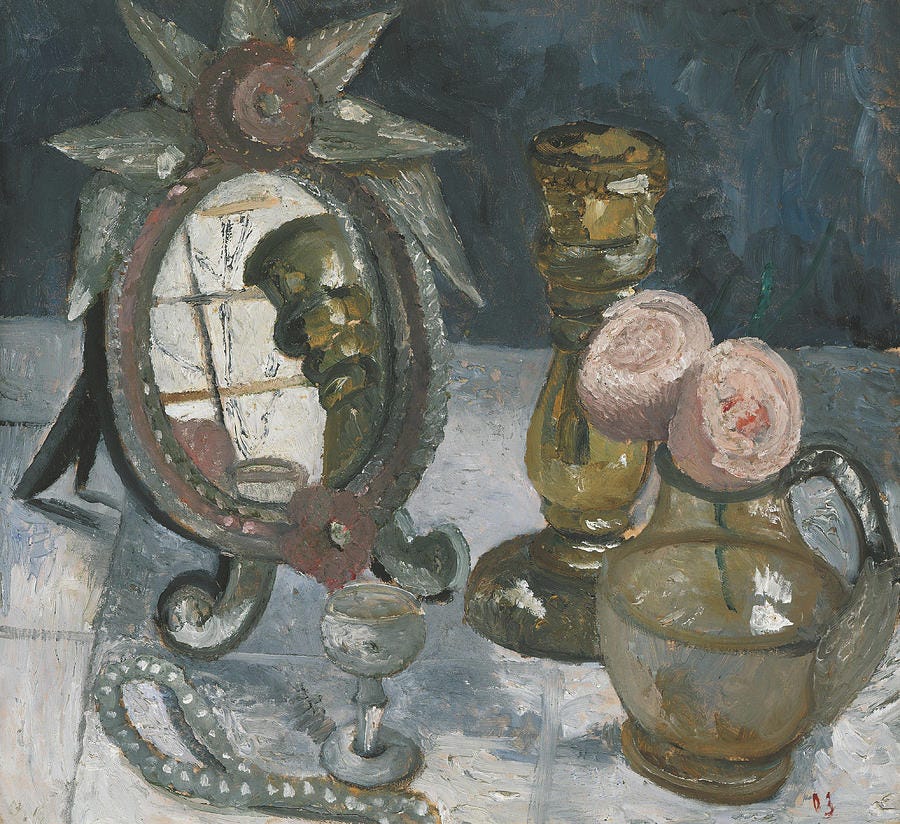
Letter to a Venetian Mirror
I would have liked to begin the story by saying, «Once there was a mirror», but I did not dare. «And in the mirror, a woman», I would continue, if my voice did not fail me so. A woman standing upright before the mirror recognizes her double desire. Then a difference slips in. And beyond the glimmer, a space seems to come into view. Perhaps a blind spot. The right hand has become the left. The eye intuits the column. The index finger caresses the tip of the arrow. I suspect that the only possible locus of reading lies precisely on this threshold, poised over the rift between what is said and what is written, suspended between the lover and the beloved. Parodying myself, I wait for the non-existent knight and, in the meantime, address the one who flickers and the one who deceives:
Contemporary stereoscopy admits no blinking.
Contemporary stereoscopy admits no blinking.
Contemporary stereoscopy admits no blinking.
What is your secret? They say there are three reasons to explain the superiority of Venetian mirrors: the salinity of the sea water, the beauty and clarity of the flame, and the quantity of salt and soda employed. I believe that the process by which these silver discs are made is analogous to the materialization of erotic desire.
The silence of those who plunge into salted waters.
The firewood burning beside the heat of the forest’s animals.
The strong and precise hands of a Murano glassmaker.
I confess I have not yet learned to distinguish the amorous pursuit from the hunting motif inscribed on your reverse.
What I do know how to do is follow whoever burnishes the copper of the obverse.
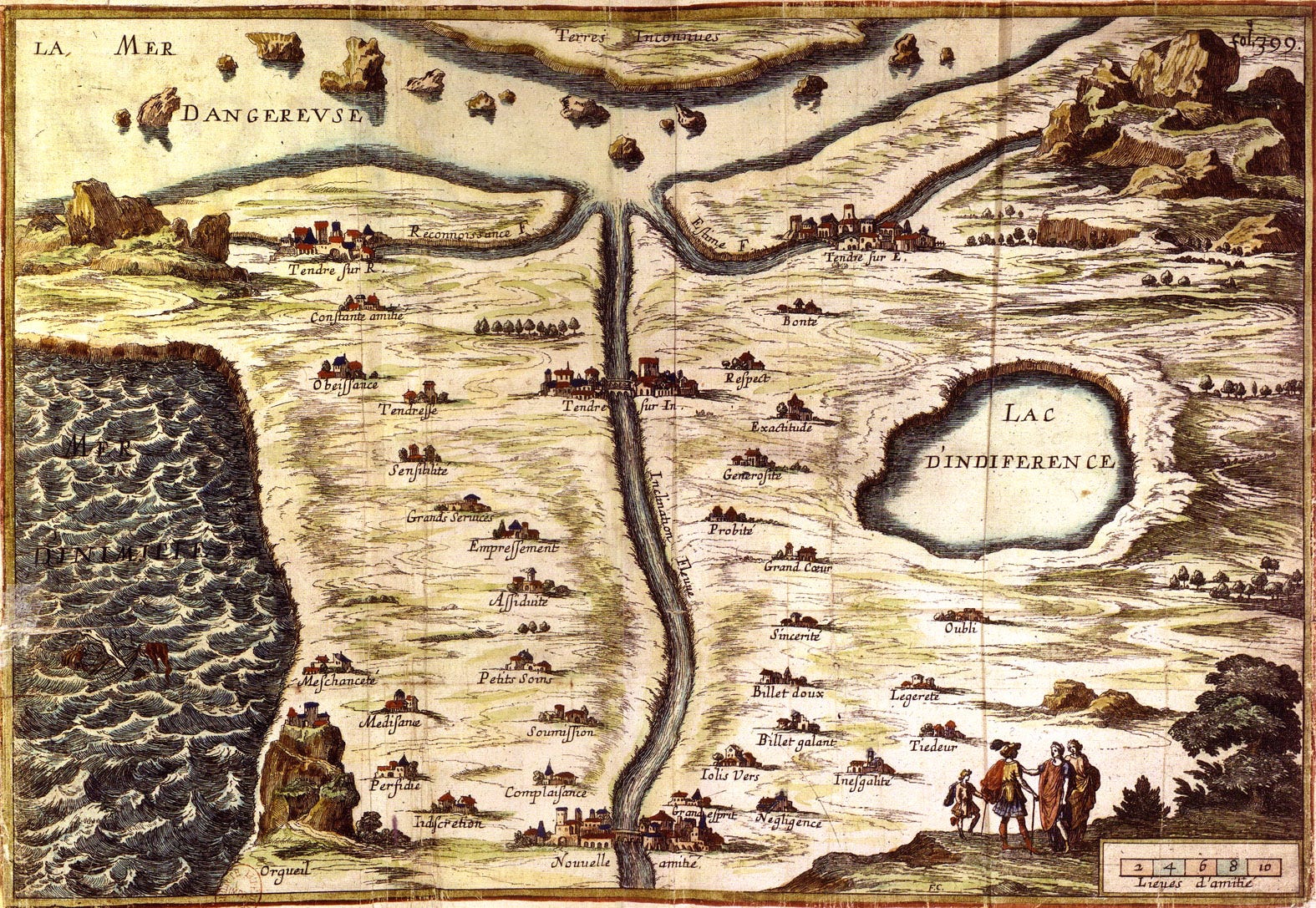
Letter to the Map of Tendre by Madeleine de Scudéry
Whenever I retrace your relief, I reaffirm the following thought: beauty as a sensuous transformation can only inhabit a geography of passages and be charted upon a tender terrain free of frontiers. That is why I offer you another kind of affection device, in the form of a letter, an exercise in calligraphy.
Remember: to write a letter is transitive beauty. And Eros acts from within it, breathing its spirit into the words.
Between wordplay and tea, your contours embody an intimate and tangible revolt that overflows into rivers, slopes, valleys, and mountains. A diagram of amorous discourse as effective as it is evocative, essential to any program of aesthetic education.
If only I could map my desire as elegantly as Madeleine de Scudéry.
If only I could map my desire as elegantly as Madeleine de Scudéry.
If only I could map my desire as elegantly as Madeleine de Scudéry.
Condemned for ardor and affectation, I reclaim myself as a daughter of her lineage of précieuses ridicules.
* * *
One last thing: do not let me fall into the Lake of Indifference, for all you hold dear!
 | A guest post by
|
🏹