

THE ALGORITHMIC SUBLIME: Transcendence, Negativity, Mediation
A virtual course hosted by Ester Freider, August 2026, is open for registration


“Yet there is a kind of collusion between capital and the avant garde… In subordinating science through technologies, capitalist economy] only succeeds in making reality appear increasingly intangible, subject to doubt, unsteady.”
– Jean-Francois Lyotard, ““The Sublime and the Avant-Garde”, 1984
How can we begin to theorize the impact of algorithm-driven content creation on art not from an ethical or metaphysical perspective, but rather from an aesthetic perspective? What does it mean to be an artist today, if we think of art’s value beyond utility, aspiration, or even hope? How do we connect 18th century theories of the natural sublime to today’s landscape of endless data, and how do we relate psychoanalytic theories of “sublimation” to our contemporary artistic habits? In a four-week reading course led by literary practitioner and multimedia artist Ester Freider, we will attempt to engage with the algorithmic sublime from a place of productive awe rather than moralising fear.
From classical rhetorician Longinus to 18th century philosophers like Burke and Kant to (near) contemporary theorists like Zizek, Lyotard, and Jameson, the sublime has long been a keyword through which philosophy interrogates overwhelm, negativity, and the limits of human reason. While the natural sublime was an important, often salvational domain for Romanticist (and American Transcendentalist) poets, painters, and thinkers, later theories have speculated on the larger aesthetic category’s collusions with and appropriations by fascist propaganda, masculinism, and the pattern of the market itself. With the emergence of the internet and its endless coagulations of data, information, eroticism, and access, the sublime became far closer at hand than the vast seas and Alpine peaks of earlier theories. The algorithmic sublime is an everyday dissolution, a habitual acid bath that we, as users and as creators, have learned to hold tension with.
Newfound user accessibility to AI tools and their integration into social media platforms has made the algorithmic sublime exponentially more close at hand as a generator for feelings of loss, alienation, and ontological displacement. Many contemporary artists are fiercely “anti-AI”, whether that mean being opposed to image generation within the work, the broader use of AI tools for artmaking and art writing, or even just topical engagement with the consequences of AI within one’s work. AI is often read as anti-human despite being a sort of infinite coagulation of human thought patterns, curiosities, and desires, with possible parallels to the transcendent domains of the religious, the cultic, and the esoteric. There is no doubt the developments of AI pose a wide variety of difficult political, ethical, and social conundra, and threaten many, if not most, livelihoods. Yet, just as artists have communed with divine (everything from shamanism to the Baroque), ideal (such as allegorical paintings from the revolutions of the Enlightenment), and abstract (Cubism, Expressionism, Minimalism) sublimities throughout history, today’s landscape poses the aesthetic challenge of communing with the algorithmic sublime.
Ester Freider’s new media experiments with “platform misuse”, performative theory, and desire capture while positioned as a young, unaffiliated artist have informed a vested interest in the relationship between aesthetics and capital. She published her bachelor’s dissertation and its entire bibliography on Are.na in 2023 as both a reflexive nod to its topical engagement with the commons and as a PR tactic which eventually led to the piece’s publication as an internationally distributed book. Recently, she has been engaging with the algorithmic sublimity of “theorygram” culture: the irrational limits of continental theory (and its sometimes, ironically, rationalizing readers) become an aesthetic ideal and a means through which the desire of others is captured. It is almost like a specular self-wounding. Throughout the reading of these texts, Ester’s experience as an artist as well as her academic background in literature will inform an interdisciplinary reading of the texts that encourage poeticism, play, and difference.
Each session will begin with a short, ten to twenty minute reflective lecture on the text, followed by an hour-long close reading of the text, and ending with a discussion period in which we connect the text to other relevant work and to our experiences with art, new media, and theory. All levels of experience with theoretical texts are welcome.
Week 1: “The Sublime and the Avant-Garde”, Jean-Francois Lyotard, 1984
What is the relationship like between the sublime and the market?
Week 2: “The Sublime Conditions of Contemporary Art”, Stephen Zepke, 2011
What relevance does “transcendental materialism” have for today’s artmaking?
Week 3: “Negative Aesthetics: AI and Non-Performance”, Luciana Parisi, 2023
How should AI impact aesthetic theories?
Week 4: “What Is at Stake at the Interface? Agents of Mediation in Digital Curation”, Kitty Whitell, 2024
How does the interface affect how we represent, consume, and produce art objects?
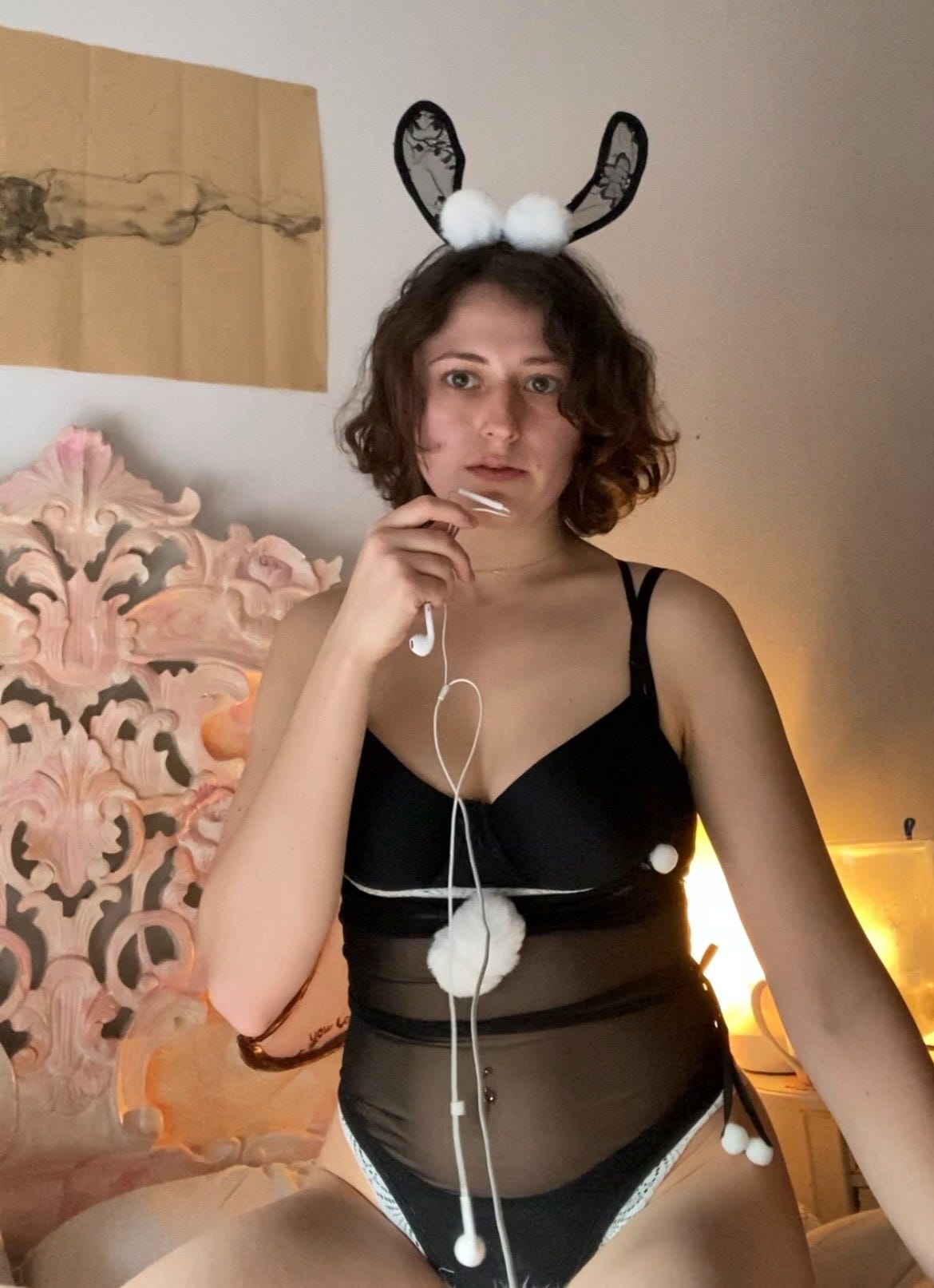
Ester Freider (b. 2002) is a Russian-American creative strategist and literary practitioner based in London. Her theoretical interests centre on the baroque, the sublime, the algorithmic, desire, pleasure, and affect from literary, philosophical, and performance perspectives. She is a co-founder and lead curator of multimedia intelligence studio Everyone is a Girl; the author of I’m Like a PDF But a Girl (Femmesocial Press, 2025) and Forever Mediated (Bimbo Rhetoric, 2025); a graduate of BA (Hons) Culture, Criticism, and Curation (CSM) and MA Comparative Literature (UCL). She lives and works in London.
@stargir1z / everyone is a girl
I’m in California but I would pay for this expeditiously